Nina Chase was recently invited as a guest speaker at the West Virginia University Davis College of Agriculture, Natural Resources, and Design to present "Urban Landscapes."
WVU School of Design and Community Development

Nina Chase was recently invited as a guest speaker at the West Virginia University Davis College of Agriculture, Natural Resources, and Design to present "Urban Landscapes."
WVU School of Design and Community Development
Nina Chase presented "It's a Test: The Power of Urban Prototyping" at Pittsburgh AIA's Pecha Kucha Pittsburgh Vo. 25 event. Check out Nina's full presentation on the Pecha Kucha website.


From the Jury: "The multi-modal nature of this is a great strength. No matter what capacity of the various audiences might be, they have provided a tool that everyone can use."
Sea Change: Boston is a research initiative on sea level rise that advocates for long-term coastal resiliency in the Greater Boston area. The Sea Change team, led by landscape architects, collaborated with experts in science, academia, advocacy, and policy-making to engage in preparedness planning at the building, city, and regional scales. Designers curated an exhibition to showcase this research, highlighting Boston's vulnerabilities and demonstrating design strategies for resilience. The exhibition shared the Sea Change research with the broader Boston community in an engaging and accessible format, rich with graphics and interactive media. Events and digital media associated with the exhibition catalyzed a conversation among designers, city officials, real estate leaders, and academics about a specific call to action: to develop a regional resiliency plan for the Greater Boston area. Outcomes of Sea Change have included authorship of Designing with Water with the Boston Harbor Association, advising for Boston Living with Water Competition, and implementation of Climate Ready Boston, Boston’s climate change vulnerability assessment.

The Erie Eco Transect has been featured on the Elevating Erie blog:
"The ideas and illustrations generated by the Elevating Erie Ideas Competition have inspired us all to think bigger as we envision the future of Erie Boulevard. Today we hear from Chris Merritt, who delivered stunning imagery of a vibrant urbanized boulevard. His proposal reads as a how-to guide on striking the ideal balance between reestablishing our rich heritage, committing to new patterns of use and investing in the core fabric of our community through an activated streetscape."

Presentation of Recommendations
"The City of Pittsburgh continues to demonstrate a successful transformation from an older rust-belt city to a city of the new economy. The city receives high marks for addressing the needs of millennials and leveraging the educational and technological opportunities associated with the myriad of universities and techy businesses . However, even with all of its recent success, many neighborhoods continue to struggle. The East End communities: East Liberty, Larimer, Homewood, Lincoln-Lemington-Belmar and East Hills suffer from high crime, low homeownership, neglected infrastructure and minimal economic development. East Liberty, with the guidance ELDI has seen the most positive transformation over the past twenty years in its the commercial core and adjacent residential areas; the other neighborhoods less so. ELDI and the city council member representing these neighborhoods asked an ULI panel to convene and provide strategic advice regarding a host of issues, including homeownership, economic development, crime and community engagement."

This summer, Chris will be working on a design research project that explores reinvention in Midwest cities. His work will focus on Cleveland, Pittsburgh, and Indianapolis. The project aims to build a collective body of knowledge on how quality design for development and public space transforms cities. Midwest cities are experiencing a renaissance, and Chris argues that a city’s investment in public space can be a fundamental catalyst for change.
Chris’ project is sponsored by the Central Indiana Community Foundation and funded through Harvard’s Graduate School of Design and the Joint Center for Housing
Nina Chase, Azzurra Cox, Scott Irvine, Joanna Karaman, Tim Mollette-Parks, and Sarah Primeau have been selected to present on the "Emerging Voices" panel at the Landscape Architecture Foundation (LAF) "Summit on Landscape Architecture and the Future" at the University of Pennsylvania, June 10-11.
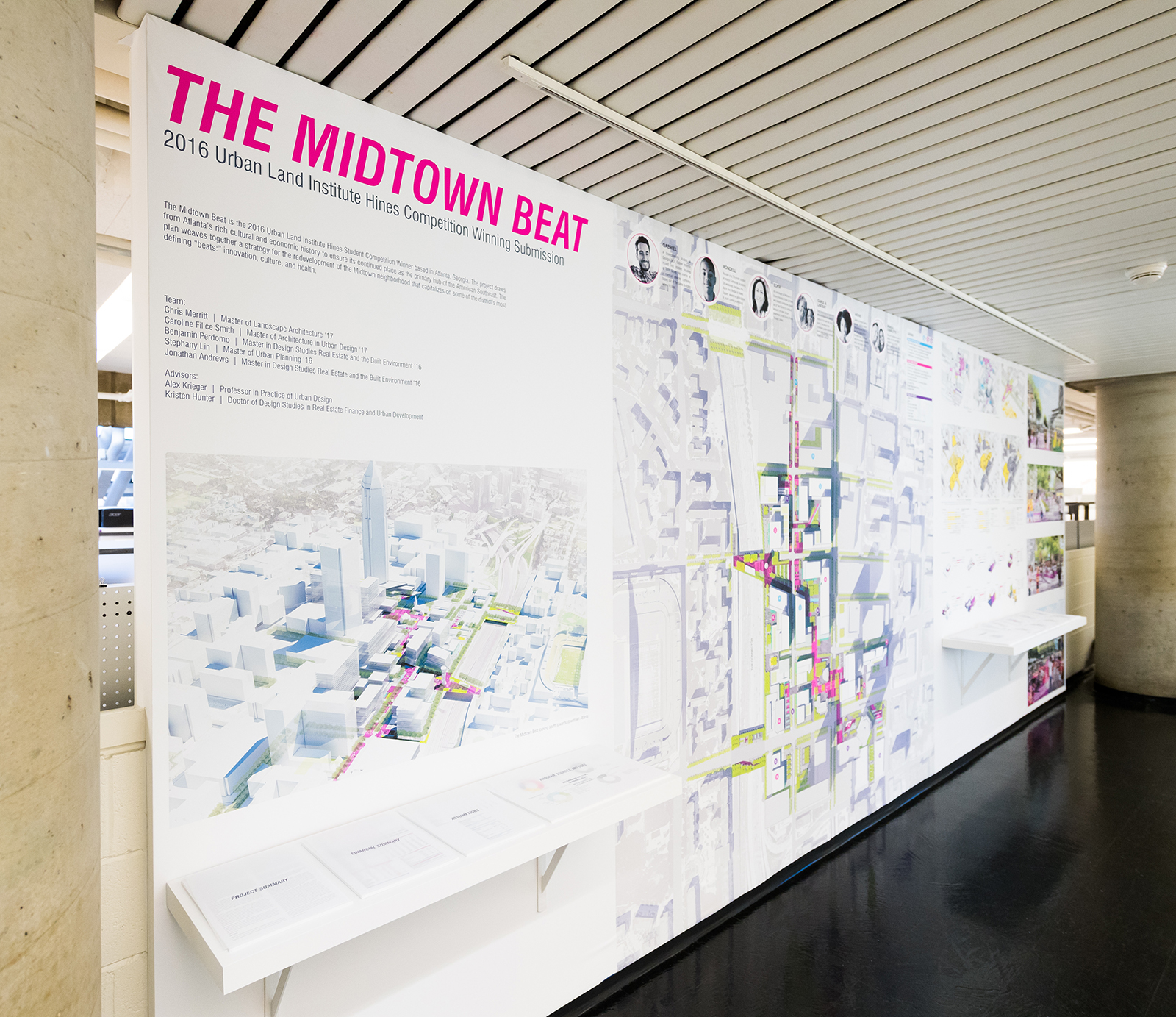
The 2016 winning submission for the Urban Land Institute Hines Competition will be exhibited at Harvard University's Graduate School of Design through Spring 2017.

Competition Website and Announcement
The "Erie Eco-Transect" was selected as a finalist in the Boulevard category to rethink Erie Blvd between Syracuse and Dewitt, New York.

The Midtown Beat has taken top honors and the $50,000 prize in the Urban Land Institute's (ULI) 2016 Hines Student Competition with a proposal to transform a Midtown Atlanta site into a sustainable, mixed-use, and thriving neighborhood.
The Midtown Beat, weaves together a strategy for the redevelopment of the Midtown neighborhood that capitalizes on some of the district’s innovation, cultural, and health components. The team was advised by Alex Krieger, professor in practice of urban design, and includes team leader Chris Merritt (MLA ‘17), Jonathan Andrews (MLA ‘17), Stephany Lin (MUP ‘16), Benjamin Perdomo (MDes ‘17), and Caroline Filice Smith (MAUD ‘17).